I help companies stop making decisions based on gut feel. Then I launched my own business on vibes.
I’m a researcher who almost did not research her own business launch. This is the story of catching myself, doing it properly and what I found.
For the past seven years, a big part of my job has been to walk into a meeting full of smart, senior people and politely but firmly tell them that the data does not support what they think is true. That their new product idea, while genuinely exciting, was only considered valuable by 2% of the target audience. That the pricing model they spent months debating was less of a factor than they assumed. That the feature they were certain users wanted was not, in fact, what users wanted.
I have done this at a moonshot lab where the ideas were genuinely audacious and the egos were proportionally sized. I have done it at a small Silicon Valley startup where moving fast was essential and slowing down to run a proper study felt almost like failure. I have done it in a more standard corporate environment where decisions moved slowly but politics could be intense and every number had to be airtight.
In all three contexts, the pattern was the same. The first layer of the job is technical: your methodology has to be completely bulletproof, because the moment someone spots a weak point, the findings become a debate about the research instead of a debate about the decision. The second layer is almost entirely human: telling a CEO that his newest idea only resonated with a tiny fraction of the market, and then actually getting him to act on that, requires a very different skill set than building a conjoint model.
I got good at both. And then I decided to go freelance.
The irony arrives quickly
Within about three weeks of going freelance, I was doing what I had spent years helping other people avoid: making significant business decisions based on a combination of intuition, anecdote, and what felt right.
I started asking other freelance consultants how they had figured out their positioning and marketing. The most common answer was some version of “I tried a few things and eventually one of them sort of worked.” Which is, to be fair, a perfectly legitimate approach to building a business. It is just also exactly the approach I have spent years arguing against professionally.
So I had a choice: quietly do what everyone else does and hope something sticks, or do what I actually believe in.
So, I ran the study.
What I actually did and why I did it this way
I had three questions I needed to answer: Which framing of my service actually drives purchase intent? Which value propositions do buyers genuinely care about? And where do they look for someone like me and under what circumstances?
I designed three modules to answer them: a between-subjects framing experiment, an anchored MaxDiff to rank value propositions and a trigger and channel mapping survey. The framing experiment meant running three separate surveys simultaneously. Each respondent would see only one version of how I describe my work, so there was no contamination between framings. This is a method I have used repeatedly for clients testing taglines, value propositions, and marketing copy. Small wording differences consistently produce bigger purchase intent gaps than people expect.
One deliberate constraint: I wanted to keep costs as low as possible while keeping quality as high as possible. That meant not using the expensive choice-based modelling platforms I normally have access to through client budgets. Instead, I built the whole thing myself: a free survey tool, a Python pipeline for the BIBD design and best-worst scoring and manual analysis for the open ends. There will be a separate article about the full 0€ MaxDiff setup for anyone who wants the technical detail.
The one thing I did spend money on was recruitment. High-quality respondents are always worth the cost and on this I did not compromise. I recruited with specific screening criteria: full-time employed, working at companies of 50 or more people, and with confirmed decision-making responsibility. Senior decision-makers at real companies without general population noise.
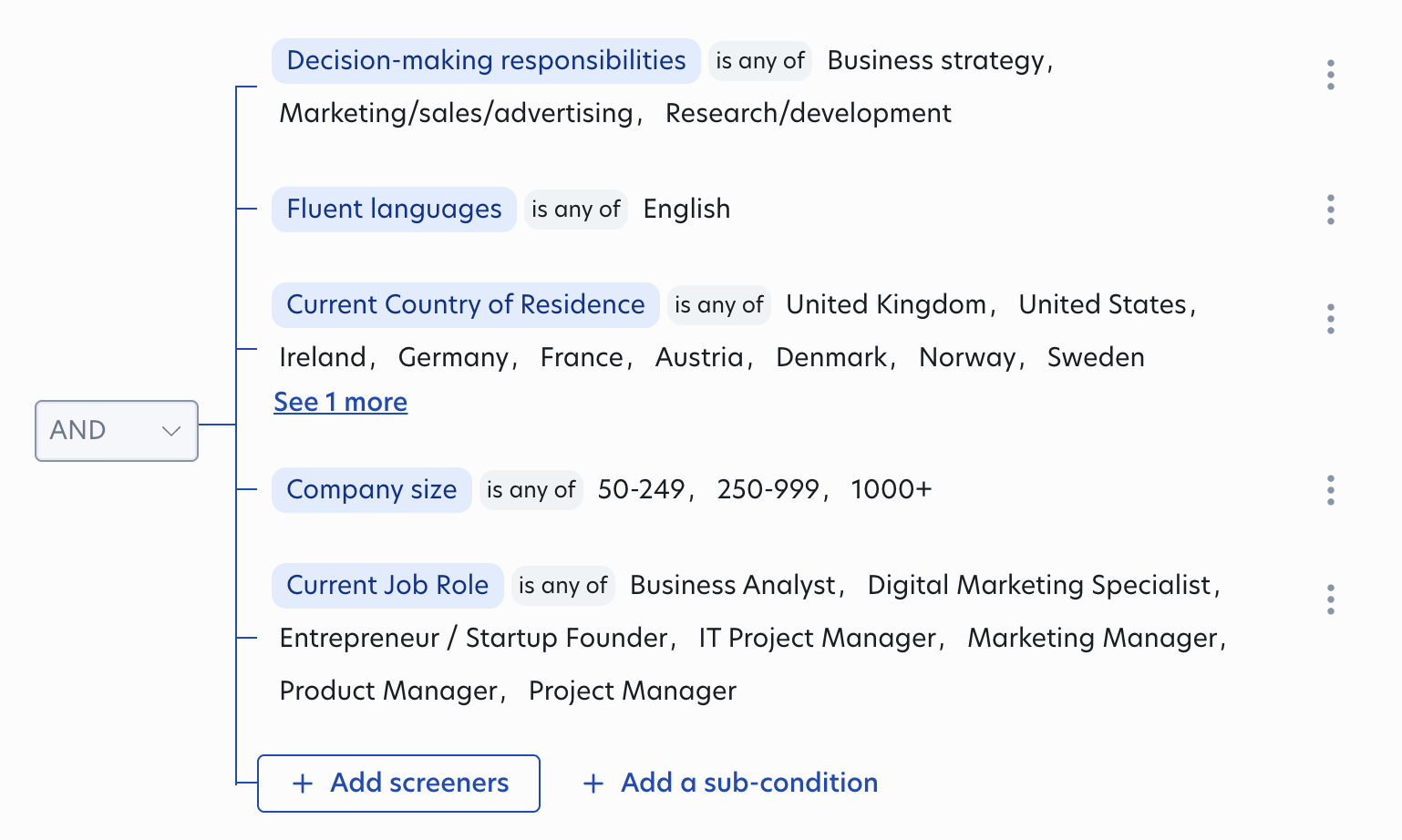
Recruitment Criteria
Oh how the tables have turned…
I launched the survey on a Thrusday afternoon. By Friday I had 90 complete responses. I opened the results that evening and within about ten minutes of looking at the data, I knew the study had been worth doing. Not because the results confirmed what I thought, but because several of them did not. The findings were clear enough that I would need to change things. And not just minor things. The framing I had been most confident about came last on the metric that actually matters. The thing I had been leading with as a differentiator turned out to be close to irrelevant to my target audience.
So here I am in the exact opposite side of the table I used to be on so many times. This is exactly what I tell people research is for. Not just to confirm your instincts but to correct them efficiently, before you spend six months and a significant budget going in the wrong direction.
The full findings are covered across three follow-up pieces:
what the framing experiment revealed about how I describe my work
what the MaxDiff showed about what buyers actually care about
what the trigger and channel data said about where and how they find researchers.
Each piece covers the findings and implications first, with the methodology at the end for anyone who wants it.
Starting with the framing experiment. That one surprised me the most.
