People loved how I described my services. They just didn't want to hire me for it.
I wrote three descriptions of what I do and tested them on 90 senior decision-makers. The version I was most confident about scored well on relevance and dead last on the only metric that matters.
This is the second piece in a series about running a positioning study on my own business. The first article covers the full story of why I did this and what the study looked like. This one covers the framing experiment. It’s the module that surprised me the most and the one with the clearest lesson for anyone trying to sell a complex service.
A gap I have seen before
Before I get to my own results, a quick detour because this finding connects to something I have encountered repeatedly in client work.
A few years ago, I ran a study for Kiwi.com extras: luggage, insurance, cancellation protection, seat selection. The assumption was straightforward: travellers want these services, so creating packages of more of them together should feel even more valuable. However, the data told a different story. Travellers genuinely wanted the high-value extras. Who wouldn’t want 3 extra bags and free cancellation? But the moment those extras were combined into a bundle and a real price appeared next to them, the whole package suddenly felt very expensive and conversion dropped. Desire and willingness to pay were two completely different things. (Full case study here.)
I have since seen versions of this gap in almost every research project I have worked on. Users say they want a feature but will not pay for it. Customers rate a concept highly but do not convert.
It turns out the same thing happens when you are the product.
The simple setup
I had been going back and forth on how to describe what I do. Every freelancer has this problem. You write something, it sounds too vague. You rewrite it, now it sounds too corporate. You rewrite it again, and a friend tells you it sounds like a LinkedIn post written by ChatGPT. So you start from scratch again.
I had three framings I kept circling between. Rather than picking one based on what felt right, which, as I mentioned in the first article, is exactly what I tell clients not to do, I decided to just test all three. The design was the most simple part of the whole study: I divided my total number of senior decision-makers by 3 and each group saw only one version of the service descriptions. Same two questions for everyone.
How relevant does this feel to a challenge you currently face?
How likely would you be to consider contracting the person offering this service?
The first question measures relevance. The second measures buying intent. They are not the same thing. That turned out to be the entire point.
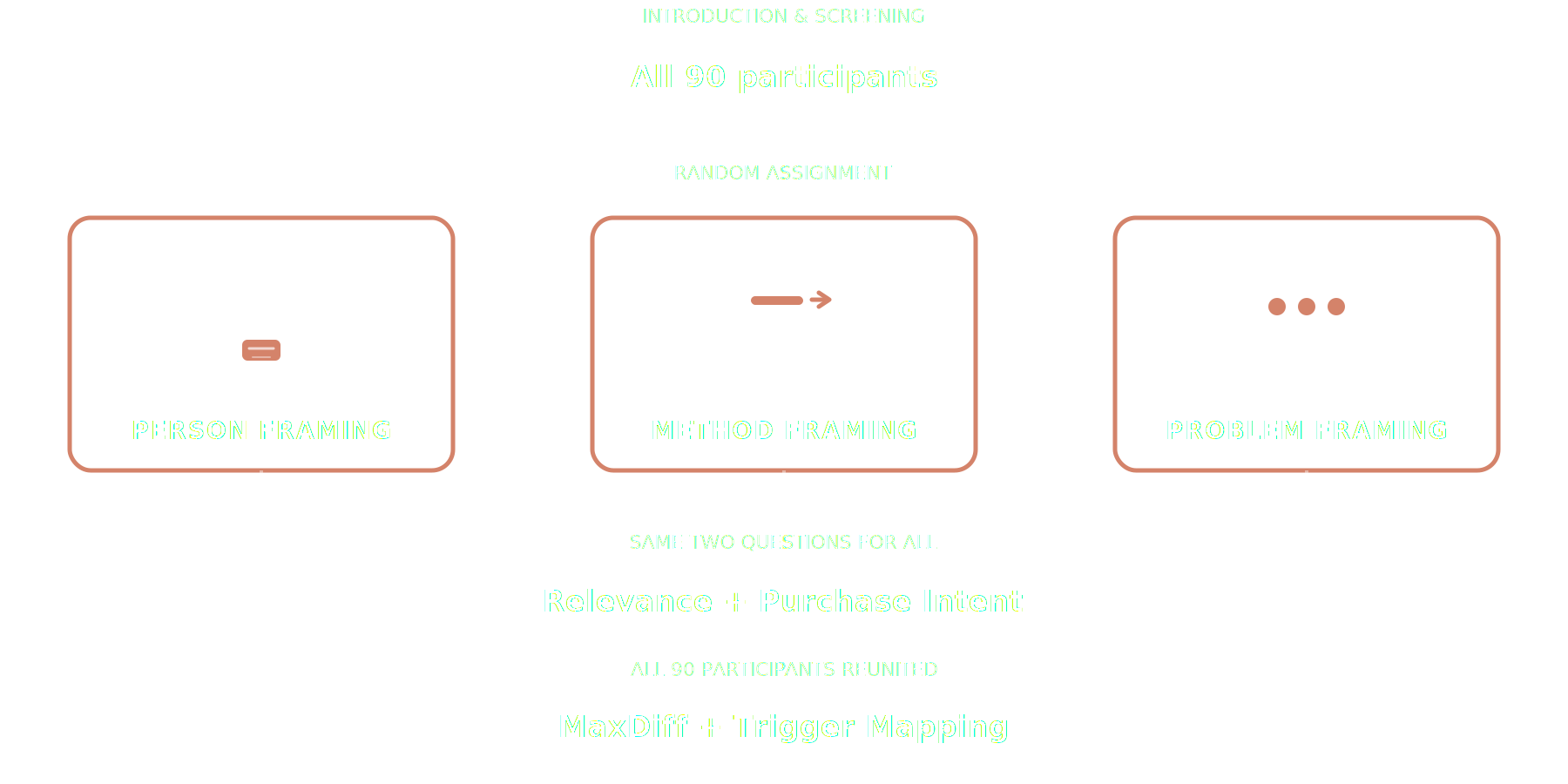
Between-subjects design to test the 3 different descriptions of my services
The person framing led with my name, my background and what I do:
"Svenja Pieritz is a Senior Quantitative UX Researcher with a background in cognitive science..."
The method framing led with the service. No name, no person, just the offer:
"A Decision Sprint is a one-week research engagement that delivers a clear, data-backed recommendation…"
The problem framing led with the buyer's pain point. No name, no person, just their world:
"The hardest product and strategy decisions are the ones where everyone has an opinion but nobody has the data…"
What I expected
Let’s be honest, I was certain the problem framing would win. I had put real thought into this and deliberately kept myself out of the copy because I thought it would be more compelling to lead with the buyer's world, their frustration, their situation, rather than with my credentials. It seemed like sales 101: nobody cares about your job title, they care about their own problem.
What actually happened
All three framings scored within a similar range on relevance. People read all three versions and thought: yes, this connects to real challenges I face. The problem framing did that job just fine. The gap showed up on the purchase intent question, which is the one that actually gives an indication on whether someone becomes a client.
The personal framing scored highest. The method framing came second. The problem framing (the one I had been most confident about) came last. And not by a trivial margin.
This is the same pattern I found in that Kiwi.com study, playing out in a completely different context. People recognised the problem. They agreed it was real. They just did not connect that recognition to a decision to buy. If you have ever watched strong survey results fail to translate into actual conversion, you have seen this gap before.
But the finding that actually changed my mind was not in the numbers. It was in what people wrote.
Credible, rich and AI-generated
The open-ended question was the same for everyone: In your own words, what is your immediate reaction to what you just read?
In the person framing group, the responses were strikingly personal. People wrote things like:
"she sounds like exactly the kind of person you'd want on a product team"
"this is an accomplished person in her field."
"credible and professional"
"the combination of cognitive science and quantitative UX research suggests a strong analytical background."
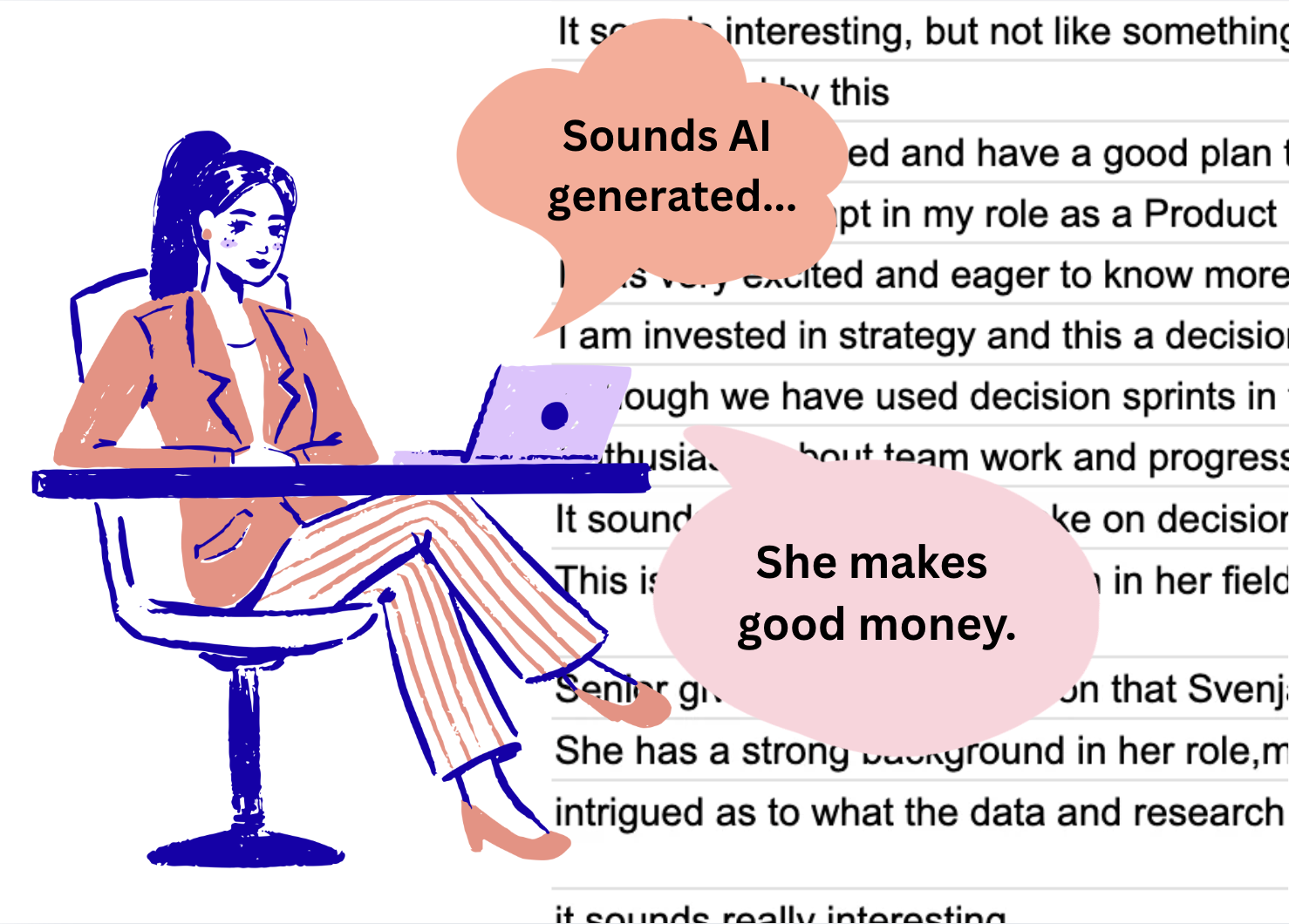
Someone else simply noted: "she makes good money." Not the reaction I was testing for but, to be honest, I don’t mind that impression either.
The point is that these responses are about a person and not about a service or a deliverable. A real human being they could picture sitting across the table from them.
In the problem framing group, the responses were polite but distant:
"Sounds practical."
"It makes sense."
"Efficient way to remove guesswork."
And one that was very relevant:
"Sounds AI generated. While it delivers the point, it does not read like a person passing knowledge."
That respondent gave it a 4 out of 5 on relevance so they thought the framing was relevant to their work. They also gave it a 1 out of 5 on purchase intent. They recognised the problem. They would not hire whoever was behind it.
That single response captures the entire finding better than any complex analysis.
Let’s get personal…
The main result of this part of the study is that a real person with a real name and a real background cuts through in a way that no amount of carefully crafted problem framing can. Not because the problem framing is wrong but accuracy alone is not enough. People want to know who is behind the service. If you leave that out, you end up sounding like everything else on the internet.
What I changed
I haven't redesigned my entire website around this finding. That would be premature based on one study with 30 people per cell and I would tell a client the same thing, but I have changed my behaviour.
I started writing articles like this one, where I walk through how I think, what I got wrong and how I work. If people want to know who is behind the service, then the best thing I can do is let them find out. Not by adding more credentials to a landing page, but by showing how I actually approach problems.
How this turns out in terms of impact is a question I cannot answer yet. But if you are reading this and have an opinion or some feedback, I would genuinely love to hear it. Send me a message or leave a comment. Consider it free qualitative data.
Next in this series: what the MaxDiff revealed about which value propositions decision-makers actually care about
Methodology note: Between-subjects design, n=30 per cell, recruited with screening for seniority and company size (50+). Two dependent measures: relevance (1-5) and purchase intent (1-5). ANOVA reached significance on purchase intent (p=.034); non-parametric Kruskal-Wallis did not (p=.054). Medium effect size (Cohen's f=0.284). With n=30 per cell the study was underpowered for small-to-medium effects. The directional finding is clear butthe inferential claim is not bulletproof.
